


There are parts of buying a lakefront home that are easy to understand. You can see the view, measure the frontage, walk the dock, look at the boat lift and decide whether the backyard feels right. Insurance is different. Most of the important details are buried in policy language, deductibles, inspection requirements and exclusions. And because insurance often enters the conversation after a buyer has already found the house, it is easy to treat it as an administrative item rather than part of the purchase analysis.
On Central Florida lakefront property, I think that is a mistake. Whether you are looking on the Winter Haven Chain, Harris Chain, Butler Chain or a smaller private lake, insurance should be evaluated alongside the roof, seawall, dock, elevation and other physical characteristics of the property. The question is not simply, “Can I get insurance?” The better question is: What exactly am I insuring, what is excluded, and how much of the risk am I retaining myself? That is where the real conversation begins.
Does Homeowners Insurance Cover the Lake Coming Into the House?
Usually, no. Most homeowners policies do not cover flood damage. Florida law is explicit enough about that distinction.png) that homeowners policies without flood coverage must include a notice advising the policyholder that flood losses are not covered and separate flood insurance should be considered.
that homeowners policies without flood coverage must include a notice advising the policyholder that flood losses are not covered and separate flood insurance should be considered.
That matters because buyers often hear the words “water damage” and assume water is water. Insurance does not look at it that way. A sudden plumbing failure inside the house can be treated differently from a sewer backup, and both are different from outside floodwater. If rising lake water or widespread surface water enters the home, you should not assume the homeowners policy will respond.
For a lakefront buyer, I would ask the insurance agent a very plain question: If the water comes from outside the house, what policy responds? You want a specific answer rather than a general assurance that you have “water coverage.”
“But It’s in Flood Zone X.”
That is useful information. It is not the end of the analysis. A lower-risk FEMA flood designation can affect whether a mortgage lender requires flood insurance, but it does not mean the property cannot flood.
On lakefront property, I care about the actual site almost as much as the letter on the flood map. How high does the house sit above the lake? Does the lot rise away from the shoreline or flatten out toward the house? Where does stormwater travel during several days of heavy rain? Are there low door thresholds, sunken patios or drainage areas that hold water? And perhaps most importantly, what has happened to the property and surrounding lake levels during previous wet periods?
Two homes on the same lake can have very different physical exposure. Flood maps are useful. They are not a substitute for understanding the lot.
If My Lender Does Not Require Flood Insurance, Do I Really Need It?
That becomes a risk decision rather than a lending decision. A lender requirement tells you whether the lender requires coverage. It does not tell you whether the property can flood.
There is also an important Citizens Property Insurance issue for Florida buyers. As of January 1, 2026, applicable Citizens personal residential policies that include wind coverage generally require separate flood insurance when the dwelling replacement cost is $400,000 or more, regardless of whether the property is inside a Special Flood Hazard Area. Beginning January 1, 2027, the requirement expands to the remaining applicable Citizens personal residential properties. Condominium unit-owner policies are exempt from this particular requirement.
That can materially change the true annual insurance cost. A homeowners quote that initially looks reasonable may look different once the required flood policy is added. This is one reason I prefer to get real insurance numbers while a buyer still has meaningful due-diligence time.
What Does Flood Insurance Actually Cover?
Having flood insurance and having every consequence of a flood insured are two different things. Under the National Flood Insurance Program, the maximum coverage currently available for a typical single-family home is $250,000 for the building and $100,000 for contents.
For some Central Florida homes, that may be adequate. For a larger custom lakefront home, it may not come close to the full rebuilding cost.
There is another point buyers frequently miss. Standard NFIP coverage does not pay additional living expenses or temporary housing while the home is being repaired after a flood. It also excludes a number of improvements outside the insured building. So “we have flood insurance” should be the beginning of the conversation, not the end of it.
With a higher-value lakefront home, it may be appropriate to ask an insurance professional about private flood insurance or additional flood protection beyond the federal program.
What About the Dock, Boathouse and Seawall?
This is one of the most important waterfront insurance questions. A homeowner naturally sees the house, dock, boat lift and shoreline as one property. The insurance contract may not.
The National Flood Insurance Program specifically excludes seawalls, bulkheads, wharves, piers and docks from standard flood coverage. That is not a small detail. A substantial dock and covered boat lift can represent a meaningful replacement cost. The same is true of a long retaining wall or seawall.
Your homeowners carrier may provide some protection for detached structures, but limits and covered causes of loss vary from policy to policy. That is why I would identify the waterfront improvements individually when requesting insurance information.
Do not simply ask, “Are the other structures covered?” Ask how the policy treats the dock, covered boathouse, boat lift and seawall. Then ask what happens if they are damaged by wind, falling trees, fire, collision, waves or floodwater. Specific questions tend to produce much more useful answers.
What About the Pool Cage?
Another Florida assumption worth testing. Screened enclosures, aluminum-framed structures and similar outdoor improvements can be treated differently from the main dwelling depending on the policy and cause of loss.
That matters because some lakefront homes have very substantial outdoor living areas. A large screened pool enclosure can span most of the rear elevation of the property and can be expensive to replace.
I would separate the questions. Is the pool covered? Is the pool equipment covered? Is the screened enclosure covered? How is the enclosure treated in a hurricane? Those answers may not all be the same.
Your Hurricane Deductible Is a Dollar Amount, Not Just a Percentage
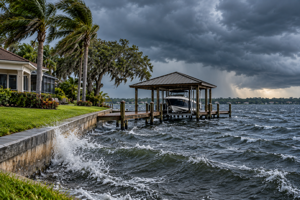 This is one of the simplest insurance concepts to underestimate. Florida homeowners policies frequently use percentage-based hurricane deductibles. State law generally requires insurers to offer specified deductible choices, subject to certain exceptions, and requires the actual dollar value of the hurricane deductible to be prominently disclosed. Florida hurricane deductibles generally apply on a calendar-year basis to covered hurricane losses under policies from the same insurer or insurer group.
The percentage becomes much easier to understand when you convert it to dollars. Suppose the house has $650,000 of dwelling coverage. A 2% hurricane deductible is $13,000. A 5% deductible is $32,500.
Those are very different financial commitments. When comparing quotes, I would not stop at the percentage. Ask the agent to show you the deductible in actual dollars. That is the amount of risk you are agreeing to keep.
Why Does Everybody Keep Asking About the Roof?
Because in Florida, the roof can affect both the availability and cost of insurance. Insurers look at age, condition and construction. A wind-mitigation inspection can also document features such as roof-to-wall connections, roof-deck attachment, secondary water resistance and opening protection.
Florida law gives homeowners some protection against roof age being used as the only reason to reject coverage. An insurer may not refuse to issue or renew a homeowners policy solely because a roof is less than 15 years old. When the roof is at least 15 years old, the homeowner must be allowed to obtain an authorized inspection before replacement is required solely because of age. If that inspection shows at least five years of remaining useful life, the insurer may not refuse the policy solely because of roof age.
That does not mean an older roof is automatically acceptable. Condition still matters. Underwriting still matters. Other issues with the property can still affect eligibility. But the statement “the roof is 15 years old, so insurance requires replacement” is too broad.
There is also a useful 2026 update. Florida's revised Uniform Mitigation Verification Inspection Form became mandatory for wind-mitigation inspections performed on or after April 1, 2026. For a buyer comparing two older lakefront homes, documented mitigation features can make a real difference.
What Is a Four-Point Inspection?
A four-point inspection is an insurance-focused inspection of four major systems: the roof, electrical, plumbing and HVAC. It is not the same thing as a full home inspection.
The home inspection is primarily about helping you understand the physical condition of the property. The four-point inspection is largely about helping an insurance company decide whether the major systems meet its underwriting requirements. Citizens currently requires a four-point inspection on new applications for applicable homes more than 20 years old.
That is particularly relevant around established Central Florida lakes. Many lakefront houses have been remodeled in stages. The kitchen may be three years old. The flooring may be new. The pool may have just been resurfaced. Meanwhile, the electrical panel, plumbing or roof may tell an entirely different story to an insurance underwriter.
A house can present beautifully and still create an insurance problem. That is why I would rather discover the issue during due diligence than a few days before closing.
Can Wind-Mitigation Improvements Really Save Money?
Potentially. Florida recognizes insurance discounts and credits for qualifying wind-mitigation features, although the.png) actual savings depend on the house and carrier.
actual savings depend on the house and carrier.
The state's My Safe Florida Home program reports that Florida homeowners who completed qualifying wind-mitigation improvements through the program and received an insurance discount saved an average of 15% on their premiums. The program also makes clear that actual savings vary.
The larger point is not that every lakefront buyer should immediately replace windows or rebuild a roof. It is that two similar homes can have very different insurance economics. One may have modern roof attachments, secondary water protection and verified opening protection. The other may not.
The properties may look equally attractive from the lake. Their insurance profiles can be very different.
Should the Insurance Amount Match What I Paid for the House?
No. Market value and rebuilding cost answer two different questions.
This distinction is especially important with lakefront real estate because a meaningful portion of the purchase price can come from the land, frontage, view, location and access to a desirable lake or chain. Insurance is primarily concerned with reconstructing the insured building.
A $1.2 million lakefront home does not automatically require $1.2 million in dwelling coverage. Conversely, an older home purchased for considerably less can still be expensive to rebuild if it has custom architecture, difficult construction details or high-end finishes.
Florida law requires insurers to offer replacement-cost and law-and-ordinance coverage options. Law-and-ordinance coverage is particularly worth understanding on older lakefront homes because rebuilding after a substantial loss may require compliance with building codes that did not exist when the house was originally constructed.
Sale price is a real estate number. Replacement cost is an insurance number. Do not assume they should be the same.
What About Sinkholes?
This is Central Florida, so the question deserves a straightforward answer. Florida homeowners policies are required to include coverage for the narrowly defined event known as catastrophic ground cover collapse. Broader sinkhole coverage is different and may be purchased separately, subject to underwriting and possibly an inspection.
Those terms are not interchangeable. For an event to meet Florida's definition of catastrophic ground cover collapse, several conditions must be present, including an abrupt ground collapse, a visible depression, structural damage to the building and a government order condemning and vacating the structure.
That is a much narrower standard than many people assume when they hear the word “sinkhole.” Being lakefront does not automatically mean a property has a sinkhole problem. But when buying in Central Florida, understanding which form of ground-collapse coverage you actually have is reasonable due diligence.
What About Liability Around the Dock, Pool and Water?
Lakefront property tends to be used differently from an interior residential lot. Guests walk onto docks. Children play near pools. People step on and off boats. Someone may fish from the seawall or swim from the shoreline.
A homeowners policy ordinarily includes personal-liability coverage, but the limits and exclusions should be reviewed for the specific property. Boats can also require separate watercraft coverage depending on the boat and policy. Buyers with substantial assets may want to discuss umbrella liability coverage with their insurance professional.
Again, none of this makes waterfront ownership inherently dangerous. It simply means the insurance program should reflect how the property is actually going to be used.
What Should You Know Before the Due-Diligence Period Ends?
Before becoming comfortable with the insurance side of a lakefront purchase, I would want the annual homeowners premium, dwelling coverage and hurricane deductible clearly understood in actual dollars. I would also want to know whether flood insurance is required or prudent, how the policy treats the dock, boathouse, lift, seawall and screened pool enclosure, and whether the roof, electrical, plumbing or HVAC systems create underwriting issues.
I would also ask whether additional protections such as law-and-ordinance, sinkhole, water backup or umbrella liability coverage deserve consideration. That is not intended to replace the advice of a licensed insurance professional. It is simply enough information to uncover many of the expensive surprises while you still have time to deal with them.
The Part Buyers Usually Learn Too Late
The real issue with lakefront homeowners insurance is not simply that there is water behind the house. It is that a homeowner naturally thinks of the property as one complete asset, while the insurance policy sees a collection of separate exposures: the dwelling, personal property, other structures, flood, wind, liability, deductibles, endorsements and exclusions.
The dock you consider part of the home may be treated very differently from the house itself. The seawall protecting an expensive shoreline may not be protected by the policy you assumed covered it. Your flood policy may repair part of the building but not pay for the temporary home you need while repairs are completed. And that innocent-looking 2% hurricane deductible can represent five figures of your own money.
None of this is an argument against owning lakefront property. It is an argument for understanding what you are buying.
My preference is to know the answers before closing. If the dock has limited coverage, know it. If flood coverage changes the annual ownership cost, know it. If the hurricane deductible represents $15,000 or $25,000 of retained risk, know it. If an aging roof or electrical system reduces your insurance options, know it while you still have the ability to make a rational decision.
Lakefront ownership already has enough variables. Insurance should not be one you discover after you own the house.
This article is for general educational purposes only. Insurance coverage, underwriting standards, premiums, exclusions and policy requirements vary by carrier and property. Buyers should review their individual circumstances and policy language with a Florida-licensed insurance professional.
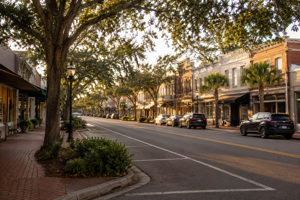 own pace of life, its own civic priorities, its own relationship to the people who live there. Clermont doesn't feel like Winter Haven. Mount Dora isn't Tavares. Two homes can sit on similar lots with similar price tags and still place their owners inside entirely different daily lives, simply because of the city surrounding them. Choosing the city before narrowing to a specific property isn't caution for its own sake. It's a practical safeguard — one that protects a buyer from a category of mistake that no amount of diligence on the house itself can undo later.
 The second reason is pace. Every Central Florida city runs at its own speed, and that speed shapes daily life more than most buyers expect going in. Some towns are unhurried, with light traffic and a slower civic tempo well suited to buyers looking for quiet. Others move faster, with weekend crowds, tourism-driven congestion, and a livelier but busier atmosphere. Neither is a flaw — but a buyer who chooses a house without first understanding the pace of the city around it can end up somewhere that technically checks every box on paper and still feels wrong within the first year. Pace of life is not something a listing photo communicates. It has to be evaluated directly, on the ground, before a house enters the conversation.
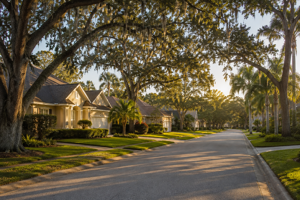 A buyer who reverses that sequence — narrowing to two or three candidate cities first, based on daily rhythm, pace, civic character, regulatory environment, and long-term trajectory — arrives at the listing stage with far better judgment. They're no longer responding to a dock and a sunset. They're evaluating a house inside a life they've already thought through, which is a far more defensible way to approach a six- or seven-figure decision.
 Central Florida is unusual in this respect. Unlike a coastline, where the water is one continuous body with a few regional differences, our interior lake systems behave more like distinct neighborhoods, each with its own personality, price structure, and set of tradeoffs. A home on the Butler Chain and a home on the Winter Haven Chain can both be described as “lakefront” in a listing, and yet the daily experience of owning them, the cost of entry, and the long-term maintenance realities can be almost nothing alike.
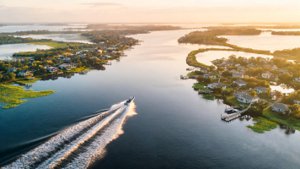 The character here is defined by scale and variety rather than uniformity. Lake Griffin still carries more marsh and vegetation, which suits certain anglers and frustrates certain boaters. The core Harris Chain includes lakes such as Harris, Eustis, Dora, Beauclair, Carlton, and Griffin, with Lake Yale technically part of the system but not navigably connected to the others. Nearby Lake Apopka, while much larger and often mentioned in the same breath, is generally treated as a separate system; it’s connected via the Apopka–Beauclair Canal and lock, but its water quality and management profile are distinct enough that buyers should think of it as adjacent rather than integral to the Harris Chain. Lake Dora and the Dora Canal, often described as one of the most scenic stretches of water in the state, offer a quieter, cypress-lined alternative to the open-water lakes.
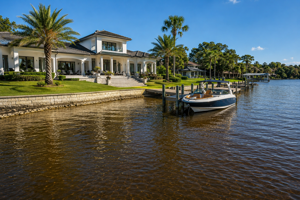 are limited—there are only a couple of public access points—and a meaningful share of shoreline access runs through private, gated communities such as Isleworth and Keene’s Pointe, where lake access is a function of community membership as much as property ownership. Wake rules are also more tightly enforced here than on many Florida lakes, with no-wake zones close to shorelines, docks, and swimming areas across the entire chain, which shapes how you can actually use a boat depending on where your dock sits.
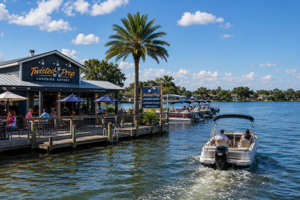 This density is the chain’s defining feature. A buyer on the Winter Haven Chain can genuinely spend a full day moving lake to lake, stopping at waterfront restaurants that sit directly on the canals, without repeating the same stretch of water twice. The lakes vary meaningfully in character within the chain itself. Some, like Lake Howard and Lake Eloise, are larger and more active, suited to skiing and open-water boating. Others are smaller, quieter, and more residential in feel. Water quality also varies lake to lake within the chain, shaped by decades of surrounding development and ongoing stormwater management work by the city, county, and state.
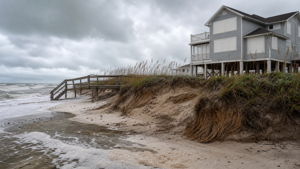 Oceanfront has its own version of the same issue. A house may have a beautiful view, but the actual value depends on elevation, dune condition, beach width, erosion history, storm exposure, construction rules, and insurance realities. A property can look calm in March and behave very differently during a named storm, king tide, or extended period of coastal erosion.
.png)
.png) Flood Hazard Area, or in a moderate-to-lower mapped risk category. That is useful information, but it is not a guarantee. A home can be outside a high-risk flood zone and still take on water from poor drainage, rising lake levels, stormwater backup, heavy rainfall, or grading that moves water toward the structure instead of away from it.
Flood Hazard Area, or in a moderate-to-lower mapped risk category. That is useful information, but it is not a guarantee. A home can be outside a high-risk flood zone and still take on water from poor drainage, rising lake levels, stormwater backup, heavy rainfall, or grading that moves water toward the structure instead of away from it. This matters on Central Florida chains. A home near a canal, public ramp, restaurant route, narrow pass, or popular open-water run may experience more boat activity than the buyer expected. That can affect privacy, dock wear, shoreline erosion, and daily enjoyment. A cove may be quieter but less convenient for boating. A wide lakefront lot may offer better views but more exposure to wind and wake. A protected canal lot may offer easier docking but less open-water drama.
 Central Florida is especially attractive for lakefront buyers because of its diverse water systems. The Butler Chain of Lakes, Harris Chain of Lakes, and Winter Haven Chain provide thousands of acres of interconnected waterways for boating, fishing, and recreation. However, not every lakefront property offers the same level of access or usability, and assumptions can lead to costly mistakes.
 Start with the waterbody itself. “Lakefront” can mean a natural lake, a chain-connected lake, a canal lot with navigable access, or an artificial waterbody that looks similar in photographs but behaves very differently in law and in use. In Florida, riparian rights are tied to land bordering navigable waters and generally include access, ingress and egress, boating, bathing, and fishing, but those rights are not the same as owning the water or the lake bottom. On navigable freshwater lakes, the state commonly holds title to sovereignty submerged lands, and on artificial waterbodies the usual assumptions buyers make about riparian rights may not apply at all. Before anything else, a relocation buyer needs clarity on whether the lot truly fronts navigable water, whether access is direct or through a canal system, and whether the rights being implied are supported by the actual legal setup.
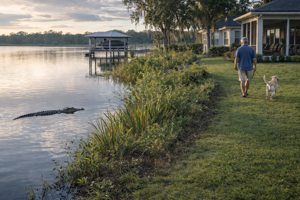 survey matters more than usual because small assumptions become real problems: a dock that is not where the owner thinks it is, a side yard path that is actually burdened by easement language, a shoreline edge that does not function the way years of casual use suggest, or a canal-front lot that does not carry the water rights a buyer assumed. Florida law is clear that riparian rights are appurtenant to the riparian land itself, and DEP’s submerged-lands framework makes clear that work in wetlands and surface waters is regulated. That is why buyers should order the survey early, review title exceptions carefully, and verify whether any dock, lift, shoreline alteration, or fill work was actually permitted. Public permitting tools from the St. Johns River Water Management District and Southwest Florida Water Management District are part of that file review.
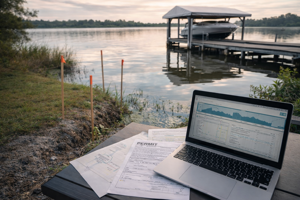 The sequence, then, is straightforward. Before going under contract, identify the true waterbody type, pull flood and homeowners insurance quotes, review available water-quality and level history, and look for obvious access or permit concerns. Once under contract, tighten the file: survey first, title exceptions next, then dock and shoreline permit history, well or septic verification, drainage and rear-yard constraints, and a home inspection that is actually scoped for waterfront ownership rather than a generic suburban house. That is the disciplined way to buy Central Florida lakefront from out of state. It does not remove every risk. It does reduce the avoidable ones.
 As a bass lake system, Harris rewards anglers who think in sections rather than just names. FWC specifically notes that Beauclair and Griffin can fish well on deeper weed lines, while other parts of the chain produce on offshore shell beds, hard-bottom areas, and the shallow canals that warm first and trigger spawning. Trophy Catch submissions remain strong, with 184 Lunker Club fish and 31 Trophy Club fish across the chain. Harris does not always get the same one-lake headline treatment as Toho or Kissimmee, but for variety, access, and all-around fishability, it is one of the best systems in the region.
 What you typically purchase is upland property that touches the water, plus a bundle of rights tied to that shoreline. Those are commonly called riparian rights (and in some contexts, you’ll also hear littoral rights for lakefront). The short version is this: in many Florida lakes, you don’t own the water behind your dock, and you often don’t own the lake bottom either. You usually own the land up to the water boundary, and you have rights of access and reasonable use—subject to regulation.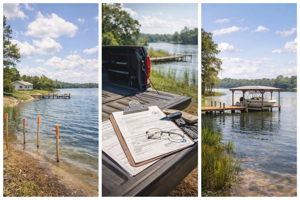
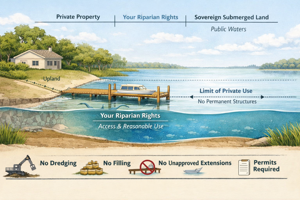 Central Florida isn’t one uniform lake system. The Butler Chain behaves differently than parts of the Winter Haven Chain. The Harris Chain mixes wide open water with tighter corridors. Canal-fed systems add flow considerations. Lake levels can be influenced by structure operations, upstream discharge, and broader watershed management. That means your “water behind the dock” is sometimes less stable—and less personal—than it appears on a calm afternoon showing.