


For an out-of-state buyer, lakefront due diligence has to start earlier than it does on a standard inland home. In Central Florida, the water is not just part of the view. It affects insurance, title, access, maintenance, permitting, and future resale. That is why the right sequence matters. The first job is not to fall in love with the setting. The first job is to identify what, exactly, is being bought and what rights and costs come with it.
 Start with the waterbody itself. “Lakefront” can mean a natural lake, a chain-connected lake, a canal lot with navigable access, or an artificial waterbody that looks similar in photographs but behaves very differently in law and in use. In Florida, riparian rights are tied to land bordering navigable waters and generally include access, ingress and egress, boating, bathing, and fishing, but those rights are not the same as owning the water or the lake bottom. On navigable freshwater lakes, the state commonly holds title to sovereignty submerged lands, and on artificial waterbodies the usual assumptions buyers make about riparian rights may not apply at all. Before anything else, a relocation buyer needs clarity on whether the lot truly fronts navigable water, whether access is direct or through a canal system, and whether the rights being implied are supported by the actual legal setup.
Once the waterbody is identified correctly, research the lake before writing an offer. Florida gives buyers better public data than many assume. Florida LAKEWATCH publishes long-term water-quality information and summary reporting, and county or regional Water Atlas tools can add lake-specific context on water quality, levels, trends, and local management. That is useful in Central Florida because not all “good-looking” lakes perform the same way over time. On some connected systems, access and recreation are part of the value proposition. The Winter Haven Chain, for example, is a 20-lake interconnected system, while parts of the Harris Chain are affected by water-control structures rather than rainfall alone. The practical question is not whether the listing photographs well. It is whether the lake’s actual condition and management fit the buyer’s intended use.
The next step is insurance, and it belongs before emotional commitment. FEMA’s Flood Map Service Center is the official source for flood hazard mapping, and FEMA is clear that standard homeowners insurance does not cover flood damage. That alone makes early flood review essential. In Florida, the insurance conversation can get more layered because Citizens has been phasing in flood-insurance requirements for qualifying personal residential policies with wind coverage. As of January 1, 2026, that requirement applies to covered properties with dwelling values of $400,000 or more, and Citizens states that all such policies are scheduled to require flood coverage by January 1, 2027. Florida’s CHOICES tool is also useful as an early pricing checkpoint for homeowners insurance, and Citizens requires a four-point inspection on homes more than 20 years old. For a relocation buyer, that means insurance quotes should be gathered before the deal gets expensive in travel, inspection, or negotiation time.
Title, survey, and access should be treated as a separate due-diligence track, not a closing formality. On lakefront, the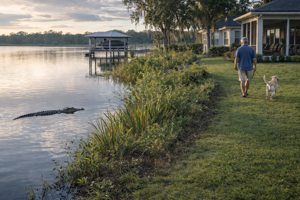 survey matters more than usual because small assumptions become real problems: a dock that is not where the owner thinks it is, a side yard path that is actually burdened by easement language, a shoreline edge that does not function the way years of casual use suggest, or a canal-front lot that does not carry the water rights a buyer assumed. Florida law is clear that riparian rights are appurtenant to the riparian land itself, and DEP’s submerged-lands framework makes clear that work in wetlands and surface waters is regulated. That is why buyers should order the survey early, review title exceptions carefully, and verify whether any dock, lift, shoreline alteration, or fill work was actually permitted. Public permitting tools from the St. Johns River Water Management District and Southwest Florida Water Management District are part of that file review.
If the property is on well or septic, treat that as another front-end filter. Florida agencies note that septic permitting and inspection remain regulated, and both the Florida Department of Health and EPA recommend routine well-water testing. Florida guidance strongly recommends annual testing for bacteria and nitrate, while EPA recommends annual testing for total coliform bacteria, nitrates, total dissolved solids, and pH, with additional testing when local conditions warrant it. For an out-of-state buyer, that means asking for system age, repair history, permit history, drain-field location, and any recent water test results before the property becomes emotionally hard to walk away from.
The shoreline itself also needs to be read more carefully than most relocation buyers expect. County stewardship materials in Central Florida routinely warn homeowners to verify buffers, conservation easements, drainage features, and management restrictions near the lake edge. That matters because buyers often picture open lawn to the waterline, aggressive trimming, shoreline cleanup, or future hardscape, then learn later that the rear yard is partially constrained by environmental or drainage rules. A lakefront parcel should be evaluated not just for view, but for how much of the waterfront edge can be used, altered, or improved legally.
Wildlife belongs in the file as well, though without drama. On Central Florida freshwater, alligators are normal. The Florida Fish and Wildlife Conservation Commission says serious injuries are rare, but it also advises keeping pets leashed and away from the water’s edge and never feeding alligators. That is not a reason to avoid lakefront. It is simply part of buying with clear eyes. A buyer who plans to live on a Florida lake should understand the practical rules of the environment, not just the aesthetics of it.
 The sequence, then, is straightforward. Before going under contract, identify the true waterbody type, pull flood and homeowners insurance quotes, review available water-quality and level history, and look for obvious access or permit concerns. Once under contract, tighten the file: survey first, title exceptions next, then dock and shoreline permit history, well or septic verification, drainage and rear-yard constraints, and a home inspection that is actually scoped for waterfront ownership rather than a generic suburban house. That is the disciplined way to buy Central Florida lakefront from out of state. It does not remove every risk. It does reduce the avoidable ones.