


Most buyers who come to me interested in waterfront start with the wrong question. They ask whether they should buy on a lake. The better question is which lake, and more specifically, which chain of lakes fits how they actually intend to live once they own it.
 Central Florida is unusual in this respect. Unlike a coastline, where the water is one continuous body with a few regional differences, our interior lake systems behave more like distinct neighborhoods, each with its own personality, price structure, and set of tradeoffs. A home on the Butler Chain and a home on the Winter Haven Chain can both be described as “lakefront” in a listing, and yet the daily experience of owning them, the cost of entry, and the long-term maintenance realities can be almost nothing alike.
This comparison walks through the three chains I get asked about most: the Harris Chain in Lake County, the Butler Chain in the Windermere and Dr. Phillips area, and the Winter Haven Chain in Polk County. The goal isn’t to crown a winner. The goal is to give you a framework for matching the mechanics of a lake system to the way you’ll actually use the water.
First, What a “Chain of Lakes” Actually Means
A chain of lakes is a group of individual lakes connected by canals, either natural or dug by hand over a century ago, that allow boats to move from one lake to another without trailering. This matters more than it sounds like it should. A single, isolated lake gives you one body of water to enjoy. A chain gives you a network. You can leave your dock, pass through a canal, and spend the afternoon on a completely different lake with different scenery, different depth, and sometimes different water quality, all without ever loading a boat onto a trailer.
That range is the appeal. It’s also where buyers get tripped up, because not every lake within a chain offers the same experience, and a home’s specific frontage—whether it sits on open water, a narrow canal, or a smaller connecting lake—changes almost everything about resale, boat traffic, and how the property actually lives day to day.
The Harris Chain: Scale and Accessibility
The Harris Chain sits in Lake County, threading through the towns of Tavares, Mount Dora, Eustis, and Leesburg. It’s one of the largest interconnected lake systems in Florida, with roughly a dozen interconnected lakes spanning somewhere in the neighborhood of 50,000–75,000 surface acres, depending on which lakes you count as part of the core chain. Lake Harris and Lake Eustis are the anchors, both well over 7,000 acres, and both deep enough in places—often 20 to 30 feet—to handle real boat traffic without the shallow, weedy frustrations some Florida lakes are known for.
 The character here is defined by scale and variety rather than uniformity. Lake Griffin still carries more marsh and vegetation, which suits certain anglers and frustrates certain boaters. The core Harris Chain includes lakes such as Harris, Eustis, Dora, Beauclair, Carlton, and Griffin, with Lake Yale technically part of the system but not navigably connected to the others. Nearby Lake Apopka, while much larger and often mentioned in the same breath, is generally treated as a separate system; it’s connected via the Apopka–Beauclair Canal and lock, but its water quality and management profile are distinct enough that buyers should think of it as adjacent rather than integral to the Harris Chain. Lake Dora and the Dora Canal, often described as one of the most scenic stretches of water in the state, offer a quieter, cypress-lined alternative to the open-water lakes.
What draws buyers to the Harris Chain is largely price relative to scale. You get access to a genuinely large boating network, small-town waterfront communities with real character—most notably Mount Dora—and public boat ramp access that isn’t gated behind a homeowners association. It tends to be the most financially accessible of the three chains discussed here, though “accessible” is relative; waterfront is still waterfront, and pricing still varies enormously by which specific lake and which specific shoreline you’re on.
The tradeoff is water quality consistency. Because the Harris Chain includes lakes at very different stages of ecological health, due diligence on the specific lake—not just the chain as a whole—is not optional. A home on Lake Eustis and a home on Lake Griffin may share a chain name, but they do not share a water quality profile.
The Butler Chain: Clarity and Restriction
The Butler Chain, sometimes called the Windermere Chain, sits in southwest Orange County around Windermere and Dr. Phillips. It is smaller than the Harris Chain—roughly 11 to 13 interconnected lakes covering about 5,000 acres, connected by about 32 navigable canals. What sets it apart isn’t size. It’s water quality and the regulatory framework built around protecting it.
The Butler Chain was among Florida’s early lake systems to receive an Outstanding Florida Waters designation, back in the 1980s, a status that carries real regulatory weight when it comes to development, stormwater management, and shoreline alteration. The lakes are strongly influenced by groundwater, which gives them a clarity that’s genuinely unusual for interior Florida lakes, with depths in places reaching 20 to 40 feet and sand bottoms in many of the swimming areas. This is the chain where “clear water” isn’t a marketing phrase. It’s a measurable, protected characteristic.
That protection comes with friction for buyers who expect easy, casual access. Public boat ramps on the Butler Chain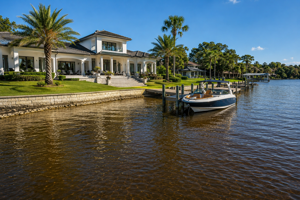 are limited—there are only a couple of public access points—and a meaningful share of shoreline access runs through private, gated communities such as Isleworth and Keene’s Pointe, where lake access is a function of community membership as much as property ownership. Wake rules are also more tightly enforced here than on many Florida lakes, with no-wake zones close to shorelines, docks, and swimming areas across the entire chain, which shapes how you can actually use a boat depending on where your dock sits.
Price reflects all of this. The Butler Chain carries the highest cost of entry of the three chains covered here, and lakefront premiums over comparable non-waterfront homes in the same neighborhoods tend to run higher and hold up more consistently across market cycles than in less regulated lake systems. Buyers drawn to this chain are typically prioritizing water quality, privacy, and long-term value stability over sheer size of the boating network or ease of casual public access.
The Winter Haven Chain: Density and Everyday Use
The Winter Haven Chain, in Polk County, is the most interconnected of the three. It’s organized into a northern chain of eight lakes and a southern chain of fourteen, linked by a system of canals and, between Lake Hartridge and Lake Conine, an actual navigational lock. Depending on how the count is drawn, the broader chain includes upward of twenty named lakes within city limits, which makes it one of the densest interior boating networks in the state.
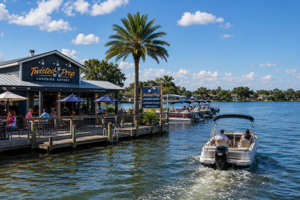 This density is the chain’s defining feature. A buyer on the Winter Haven Chain can genuinely spend a full day moving lake to lake, stopping at waterfront restaurants that sit directly on the canals, without repeating the same stretch of water twice. The lakes vary meaningfully in character within the chain itself. Some, like Lake Howard and Lake Eloise, are larger and more active, suited to skiing and open-water boating. Others are smaller, quieter, and more residential in feel. Water quality also varies lake to lake within the chain, shaped by decades of surrounding development and ongoing stormwater management work by the city, county, and state.
Pricing on the Winter Haven Chain generally sits below the Butler Chain and can be competitive with or below parts of the Harris Chain, depending on the specific lake and shoreline. Public access is comparatively strong, with numerous public docks and boat ramps scattered throughout the system. For buyers who want an active, boat-centric lifestyle with a lot of variety and a lower barrier to entry than Windermere, this chain tends to be the practical fit. For buyers whose top priority is pristine, spring-fed clarity, it is worth setting expectations accordingly; this is a working, actively used chain, not a protected preserve.
How to Actually Decide
Once you strip away the marketing language, the decision usually comes down to a short list of practical questions, and I’d rather you ask them before you fall in love with a view than after.
-
How do you actually intend to use the water: skiing and open-water boating, quiet fishing, paddling, or mostly just looking at it?
-
Is public boat ramp access important to you, or are you comfortable with access that runs through a private or gated community?
-
Where does your tolerance sit on water clarity and ecological variability across a chain?
-
What is your realistic budget once you account for the lakefront premium specific to the chain you’re considering, not a citywide average?
-
Are you buying on open water, a narrow canal, or a smaller connecting lake, and do you understand how that specific frontage affects wake exposure, dock permitting, and resale?
None of these questions has a universally correct answer. A retired couple who wants quiet mornings with coffee on the dock is going to be well served by a different lake than a family that wants to ski every weekend and host large groups. Both can find what they’re looking for in Central Florida. The mistake isn’t choosing the “wrong” chain. It’s choosing a chain—or a specific lake within it—without first being honest about how you’ll actually live on the water once the closing is behind you.
The Bottom Line
The Harris Chain offers scale and relative affordability, with water quality that varies meaningfully by lake and requires real due diligence. The Butler Chain offers clarity, regulatory protection, and long-term value stability, at the highest cost of entry and with more restricted access. The Winter Haven Chain offers density, everyday usability, and a strong boating culture at a more moderate price point, with the understanding that it’s a heavily used working system rather than a preserved one.
There’s no version of this comparison that ends with a single recommendation, because the right answer depends entirely on you, your budget, and how you plan to spend your Saturdays. What I can tell you is that the chain you choose will shape your ownership experience more than almost any other single decision in the buying process, and it deserves the same level of scrutiny most buyers reserve for the house itself.